
Historic US-Russian Collaboration: A Model for the Future
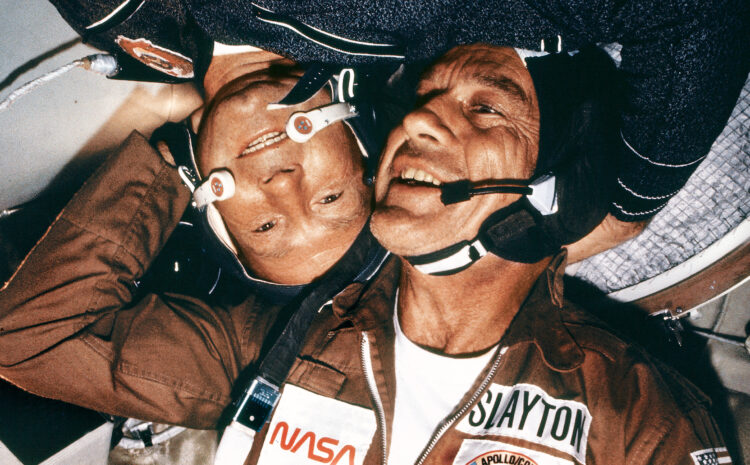
(L-R) American astronaut Deke Slayton and Russian cosmonaut Aleksey Leonov frolicking during US-Soviet Apollo Soyuz linkup.
At several points throughout our conference, both US and Russian participants observed that they knew extraordinarily little about historic examples of cooperation between the two countries. They noted that our media, education system, and larger culture have emphasized the lowest points in our shared history to the exclusion of the bright spots: areas of collaboration that have not only benefited our bilateral relationship, but all of humankind. All agreed that it is imperative that we study these examples to create a framework for future cooperation. This post will focus on two examples of our past collaboration: the ARA and the Apollo-Soyuz Mission.
The American Relief Administration During the Russian Famine
Between 1921 and 1923, Soviet Russia experienced a horrific famine that led to the deaths of millions of people. Several factors created and exacerbated the famine, including severe drought, a dismantled transportation system, and war. Many were forced to eat weeds with ground up bones, tree bark, and clay to get enough calories to survive. It is estimated that 5-10 million people perished.
In September of 1921, boats carrying supplies from the US arrived in Soviet Russia. The American Relief Administration, under the direction of Herbert Hoover, provided 11 million people per day at 19,000 kitchens. This endeavor employed over 120,000 Russians, aiding economic recovery. The ARA also planted seeds from the American Midwest as a long-term solution to address future famine.
The Apollo-Soyuz Mission
During a détente during the Cold War, NASA and Roscomos were participated in the first crewed international space mission. On July 17, 1975, Tom Stafford, Donald K. “Deke” Slayton, and Vince Brand of the Apollo module met with Aleksey Leonov and Veleriy Kubasov of the Soyuz module. During this space mission, they performed joint scientific experiments that helped further humankind’s understanding of space. Many laud this milestone as the end of US-Soviet space race and a welcome reprieve from the tensions that had dominated the relationship.
Sources:
Administrator, N. (2015, April 10). The Apollo-Soyuz test project: An Orbital partnership is born. Retrieved March 18, 2021, from https://www.nasa.gov/multimedia/imagegallery/image_feature_2309.html
Haven, C. (2011, April 04). How the U.S. saved a starving Soviet Russia: PBS film highlights Stanford SCHOLAR’S research on The 1921-23 famine. Retrieved March 18, 2021, from https://news.stanford.edu/pr/2011/pr-famine-040411.html
The library Modern Records centre. (n.d.). Retrieved March 18, 2021, from https://warwick.ac.uk/services/library/mrc/archives_online/digital/russia/famine/